A good nose is only the beginning
A dog stops, lifts its head and turns into the breeze. To the people watching, the patch of bush might look empty. To a trained search dog, the air may contain a clue worth following.
Search-and-rescue dogs help teams locate missing people. They are not simply pets with impressive sniffing skills: they work alongside trained handlers, within organised search operations. Here, “rescue dog” means a dog doing rescue work, rather than a dog adopted from a shelter, although an individual can be both.
The interesting question is not just “Which breed is best?” It is “Which dog, handler and search discipline belong together?”
What do search dogs actually do?
1. Follow a particular person's scent
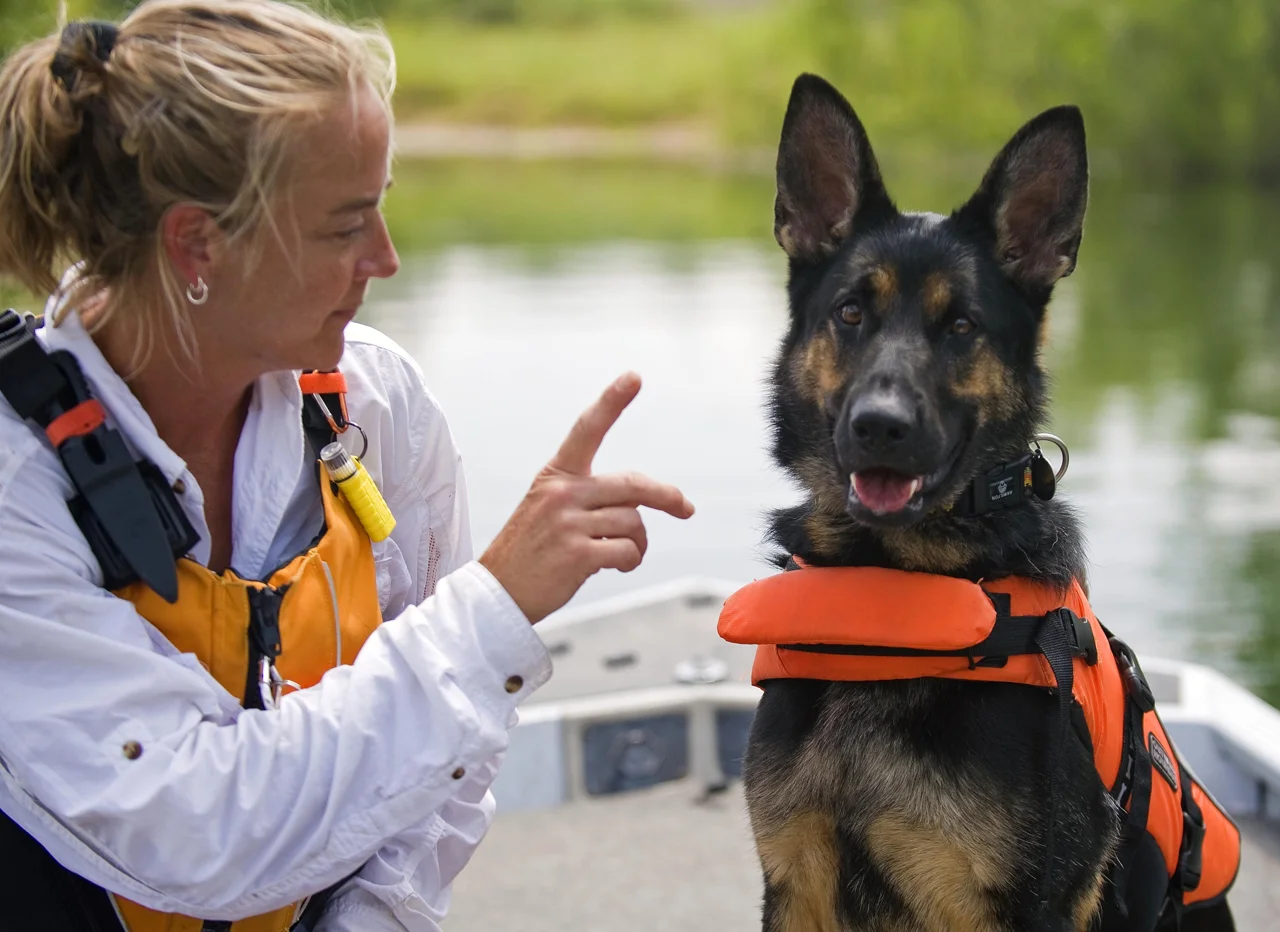
In scent-specific trailing, a dog is given a scent article associated with the missing person and works on a line with its handler. It is trying to follow that person's scent, not simply find any nearby human. NSARDA explains its trailing and air-scent disciplines.
Tracking and trailing are related terms, but should not be treated as identical instructions. In a simplified comparison, tracking concentrates on a ground route, while scent-specific trailing follows an individual's scent trail. An illustration of footprints alone can therefore give the wrong impression: a dog's work is not necessarily a neat replay of every footstep.
Australian capability is varied. VRA Rescue NSW Search Dogs lists scent-specific trailing among its operational disciplines, alongside area, water and human-remains searches. Not every organisation trains every type of search.
2. Search an area using scent in the air
Air-scent dogs work through a designated area to locate human scent carried in the air. They do not necessarily need to follow the missing person's original route. SARDA describes its live-find dogs as searching off-lead, detecting airborne scent and working towards its source. This is trained, directed work, not permission to release a pet into bushland. SARDA's detection disciplines.
Wind and terrain affect where scent travels. A handler must put the dog in a useful position to search, read its behaviour and adjust the plan. A tidy cone of scent in a diagram is a teaching aid, not a promise that scent behaves neatly in real conditions. Mountain Rescue Search Dogs England.
3. Locate someone hidden in a disaster environment
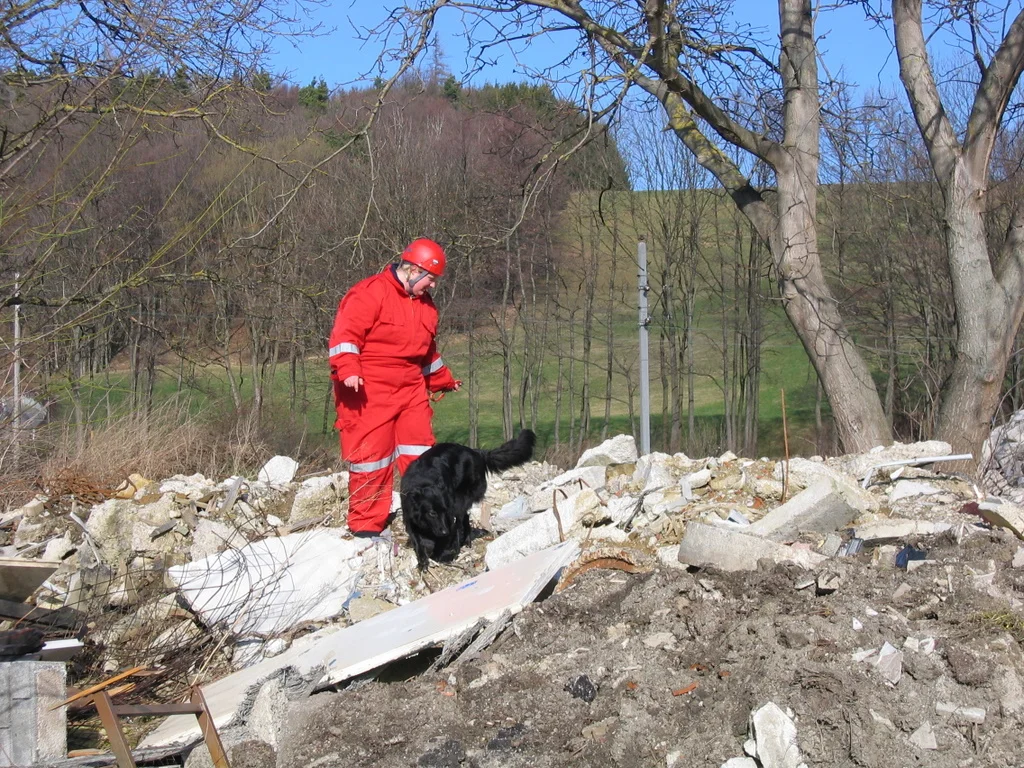
Urban search-and-rescue dogs may help locate people trapped after a building collapse or other disaster. The dog indicates where it detects the target scent; the wider rescue team then investigates and manages access. It is not the dog's job to drag a casualty out or decide that a structure is safe.
A September 2026 International Search and Rescue Dog Organisation training report describes dogs learning to identify scent outlets precisely and maintain a clear bark alert. Skills and difficulty are built progressively under specialist supervision. A rubble-search scene belongs in a controlled professional training context, never a DIY obstacle challenge for a family dog.
Which breeds are suitable?
There is no universal winning breed. The following are useful examples to discuss with a search organisation, not a shopping list or a ranking.
Labrador and Golden Retrievers
These breeds appear in the American National Disaster Search Dog Foundation's recruitment and training programme, alongside other breeds and crosses. Its selectors seek exceptional energy, focus, athleticism and motivation to work, not merely a friendly family-pet reputation. A relaxed retriever who enjoys a short walk and sofa time is not automatically a search candidate. Search Dog Foundation programme.
Read our Labrador Retriever and Golden Retriever profiles for broader ownership considerations, rather than operational selection advice.
Border Collies and Australian Kelpies
Search Dogs Sydney names Border Collies and Kelpies among working-type candidates, while emphasising the individual dog's drive and personality. Stamina, willingness to approach strangers and safe behaviour around people and dogs matter. Being quick to learn commands or enthusiastic about chasing a ball is only part of the assessment. Search Dogs Sydney FAQ.
Our Border Collie and Australian Kelpie profiles explain their everyday needs. A working ambition should never replace a realistic plan for the dog's whole life.
German Shepherds and Belgian Malinois
The American Rescue Dog Association includes these breeds among possible candidates, but explicitly warns that breed alone does not produce a suitable search dog. A stable temperament and strong training foundation are essential.
Do not choose a Malinois simply because it looks impressive in emergency-service photographs. First ask an experienced team to explain its selection criteria and the daily commitment. Compare our German Shepherd and Belgian Malinois profiles with your actual household, experience and support network.
Mixed breeds and dogs outside the usual shortlist
A pedigree is not an entry requirement everywhere. The Canadian Search Dogs Association reports experience with many breeds and mixes and focuses on the individual working partner. Its guidance also considers size, fitness, conditions and whether a handler could carry the dog in an emergency.
Smaller dogs should not be dismissed as incapable of using their noses. IRO's account of Parson Russell Terrier Arvi describes his training and rubble examinations. That is an example of individual achievement, not evidence that every small terrier meets every organisation's operational requirements.
The qualities behind a promising candidate
Think about the whole dog, not just its nose:
- Motivation: Does the dog want to keep working for an appropriate reward?
- Social confidence: Can it encounter unfamiliar people and dogs safely?
- Environmental confidence: Can it learn to cope with unfamiliar settings without being overwhelmed?
- Physical suitability: Is its health, fitness and build appropriate for the proposed work?
- Partnership: Can it search independently while still responding to its handler?
SARDA's selection guidance emphasises stamina, agility and the balance between independence and control. Selection also applies to the human. Expertise in a dog sport does not automatically translate into operational search competence.
A sensible first step is to meet a suitable organisation before choosing a dog specifically for this career. Ask how it assesses candidates and what happens if the partnership is not a match. A change of direction is better than pushing an unsuitable dog into stressful work.
What training is involved?
The exact programme depends on the organisation and discipline. Broadly, a team builds several connected skills.
Foundations: Social confidence, everyday control, reward-based engagement and a reliable relationship with the handler come before complex searches. The California Rescue Dog Association describes socialisation, obedience and safe obstacle negotiation as parts of its training. CARDA FAQ.
Finding people: Organised training uses people who hide in planned scenarios. SARDA explains that these volunteers learn about dog behaviour and rewarding successful finds. Their role is important: the exercise should teach a clear task, not confuse or frighten the dog. SARDA training.
Communicating the find: A dog needs a trained indication that its handler can recognise. Methods vary. Mountain Rescue England and Wales describes indication commonly involving barking; do not assume every team uses the same alert. Mountain rescue search-dog explanation.
Working under changing conditions: The team gradually tackles different locations and search problems. Ongoing assessment matters as much as an exciting successful practice session. One clever find does not demonstrate operational readiness.
Training the handler: Navigation, communications, first aid, search knowledge and teamwork are not optional extras. VRA Rescue NSW also identifies support roles in logistics, liaison and training. The dog's contribution sits within a much larger response, not outside it. VRA Rescue NSW Search Dogs.
How long does it take?
Expect a substantial commitment, not a weekend certificate. Search Dogs Sydney says teams typically train consistently for 18–24 months before testing for operational status, with 300–500 hours of structured dog training per year, plus handler education. Those are that organisation's published expectations, not a national timetable. SDS training FAQ.
SARDA's membership information asks prospective members to consider weekly training, workshops and potentially up to two years before formal assessment begins. Confirm its current intake and requirements directly. Becoming a SARDA member.
Assessment, deployment authorisation and continuing training are separate from choosing a breed or finishing a recreational course. Ask the organisation which standards it currently uses and how teams maintain readiness.
Could my pet try something similar?
If the attraction is giving your dog a satisfying nose-based activity, supervised recreational scent work may be a better starting point than an operational commitment. Our dog-sports guide compares activities for ordinary owners.
Do not self-deploy to a missing-person search, enter damaged buildings or recreate hazardous rubble exercises. If someone is missing, contact police rather than treating it as a chance to test your dog. Follow the responsible authorities' directions.
You can also help without becoming a handler. SARDA describes support volunteers who assist with administration or act as training “survivors”. That can be a useful way to understand the work before deciding whether handling is right for you. SARDA volunteering.
The takeaway
The most suitable search dog is not necessarily the most fashionable working breed, the fastest learner in puppy class or the pet with the loudest bark. It is an individual matched to a task, a capable handler and a training organisation that puts welfare and reliable teamwork first.
The remarkable part is not that dogs have noses. It is the patient work that turns canine ability into a dependable partnership when people need help.