

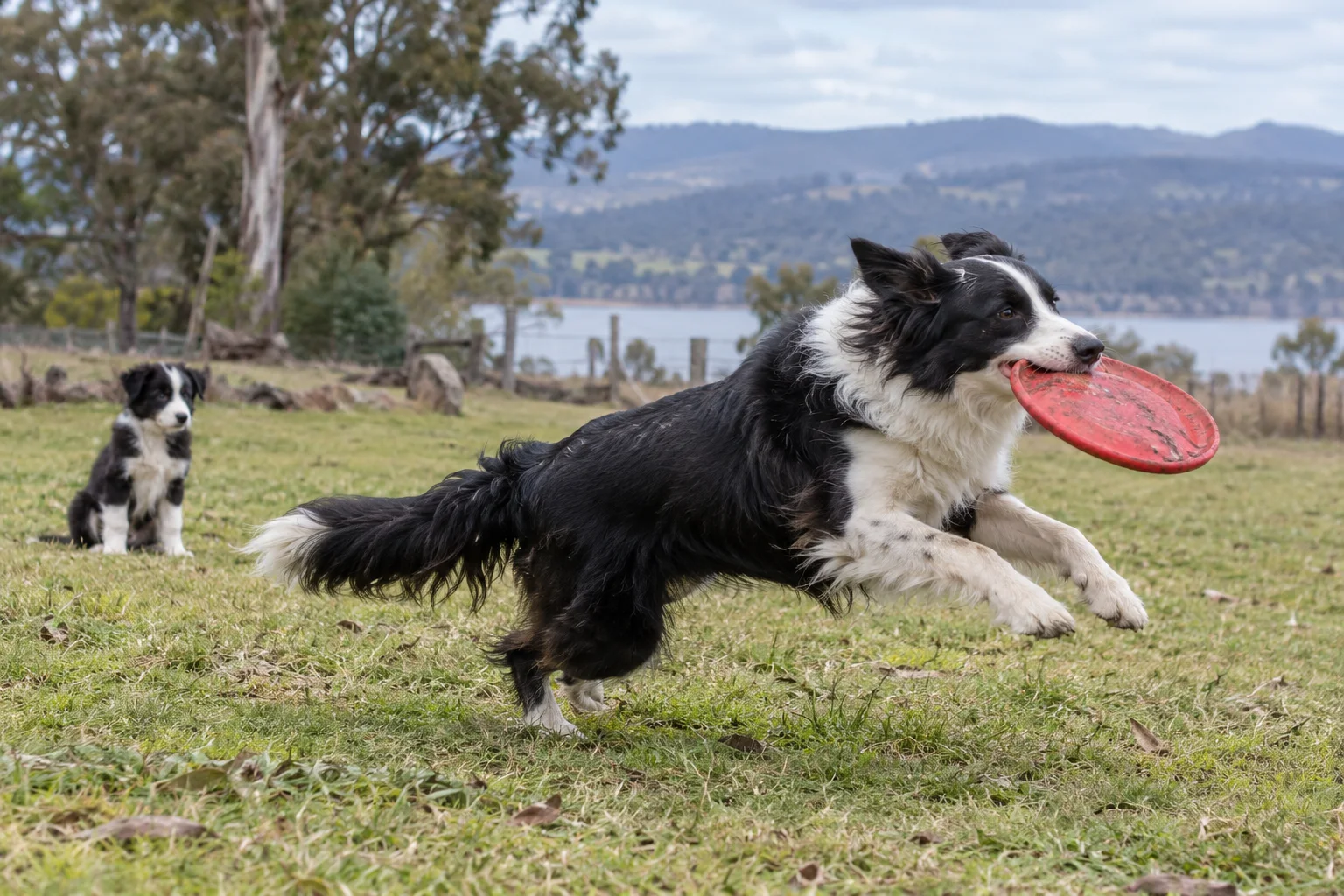
The Border Collie was developed to work livestock with speed, control and close attention to its handler. That history still shapes the modern family dog. Dogs Australia describes the breed as intelligent, athletic, faithful and willing to please—but intelligence is not the same as automatic good behaviour. A Border Collie learns whatever is practised, including habits the family never meant to teach.
- Typical fit: active, engaged owners who enjoy training
- Activity: high, but best balanced with sniffing, thinking and rest
- Coat: smooth or moderately long; regular brushing required
- Training: highly responsive and sensitive to clear, kind handling
- Big commitment: daily purpose, management and teaching calm behaviour
What is a Border Collie’s temperament like?
Many Border Collies are intensely observant, quick to respond and closely bonded to their people. They may notice tiny movements, react to changes in routine and anticipate what happens next. Individual temperament varies, and working lines may differ from dogs bred primarily for show or companionship.
The instinct to control movement can appear as staring, stalking or attempting to herd children, cyclists, other pets or cars. Chasing vehicles is especially dangerous. Use secure fencing and a lead where appropriate, teach alternative behaviours early and seek professional help before a pattern becomes established.
How much exercise does a Border Collie need?
A healthy adult usually needs substantial daily activity, but simply adding more running can create an ever-fitter dog who still cannot settle. Dogs Australia highlights the value of combining physical exercise with mental stimulation. Think varied walks, sniffing, training, controlled games and appropriate dog sports—not endless ball throwing.
Puppies should not be pushed through repetitive jumping, sharp turns or long forced runs while they are growing. Adjust activity for age, weather and health. In Australian heat, exercise during cooler hours, provide shade and water, and stop if the dog shows heavy panting, weakness, confusion or other signs of overheating.
Mental stimulation without creating obsession
Border Collies often enjoy scent work, trick training, obedience, agility foundations and practical household tasks. Keep sessions short and finish while the dog is successful. Rotate activities instead of offering constant high-arousal play.
Repetitive ball or light chasing can become difficult for some dogs to disengage from. Mix excitement with calm skills: settle on a mat, wait at doors, search for scattered food, chew quietly and sleep undisturbed. Rest is a life skill, not a failure to entertain the dog.
Training a Border Collie
Reward-based training suits a dog that notices small details. Be consistent about which cue means what and reward calm choices as generously as flashy performance. Important everyday skills include recall, loose-lead walking, leaving moving objects, comfortable handling and relaxing while the household is busy.
Socialisation should build confidence, not flood the puppy with experiences. Introduce new people, animals, surfaces, sounds and environments at a distance where the puppy can still eat, play and recover. Some Border Collies are environmentally sensitive, so forcing contact can make fear worse.
Coat and grooming
Border Collies may have a smooth coat or a longer, feathered coat. Brush regularly to remove loose undercoat and prevent tangles, paying attention behind the ears, around the tail and on the legs. Check paws, nails, ears and skin as part of the routine. After walks through long grass, inspect carefully for grass seeds and ticks.
Do not shave a healthy double coat merely to keep the dog cool. Speak with your veterinarian or an experienced groomer if the coat is severely matted or if there is a medical reason for clipping.
Health questions to ask a breeder
Responsible breeders should discuss health and temperament openly and provide results for the actual parents. Ask about hip and elbow assessment, eye examinations and DNA tests relevant to Border Collies. Dogs Australia notes that DNA testing is available for neuronal ceroid lipofuscinosis, an inherited neurological disease found in the breed.
Also ask about epilepsy, hearing, joint problems and any recurring conditions in the family line. A DNA panel is useful only when it includes validated, breed-relevant tests and is interpreted properly; it does not replace physical screening or honest family history.
For your own dog, maintain routine veterinary care and seek advice for seizures, vision changes, persistent lameness, unusual weakness, significant anxiety or any sudden behavioural change.
Can a Border Collie live with children or other pets?
Many live happily in families, but the match depends on the individual dog, the children’s behaviour and adult supervision. Herding, chasing and nipping at movement need early management. Give the dog a quiet place where children do not follow, and never leave young children and dogs together unsupervised.
Introductions to cats and smaller pets should be gradual and carefully managed. A dog with strong chase behaviour may not be safe with every animal, regardless of training.
Is a Border Collie right for you?
Picture the busiest hour in your house: children arriving home, a cat crossing the room, deliveries at the gate or bicycles passing the fence. Can an adult manage the dog calmly during that hour? For a dog that watches and follows movement closely, the household's ability to prevent chasing matters as much as its enthusiasm for long walks.
Plan a separate, comfortable resting area and a way to keep the dog away from running games when necessary. Do not give a puppy the job of supervising children or expect a cat to teach it manners. If stalking, chasing or nipping is already happening, prevent further rehearsals and seek help from a qualified reward-based professional. Children should not be responsible for correcting it.
Then consider the quieter parts of the week. Will someone enjoy short training sessions, sniffing walks and teaching the dog to settle, even when there is no outing or sport planned? A large garden does not answer those questions, and a keen runner may still find the daily management demanding.
Ask the breeder or rescue about the particular dog's response to movement, unfamiliar settings and downtime, as well as the background of its relatives where known. These answers cannot guarantee behaviour, but they are more useful than choosing on intelligence alone. A Border Collie is a stronger prospect for a household that enjoys this ongoing teaching; it is a poor choice if success depends on the dog entertaining itself between occasional bursts of exercise.