
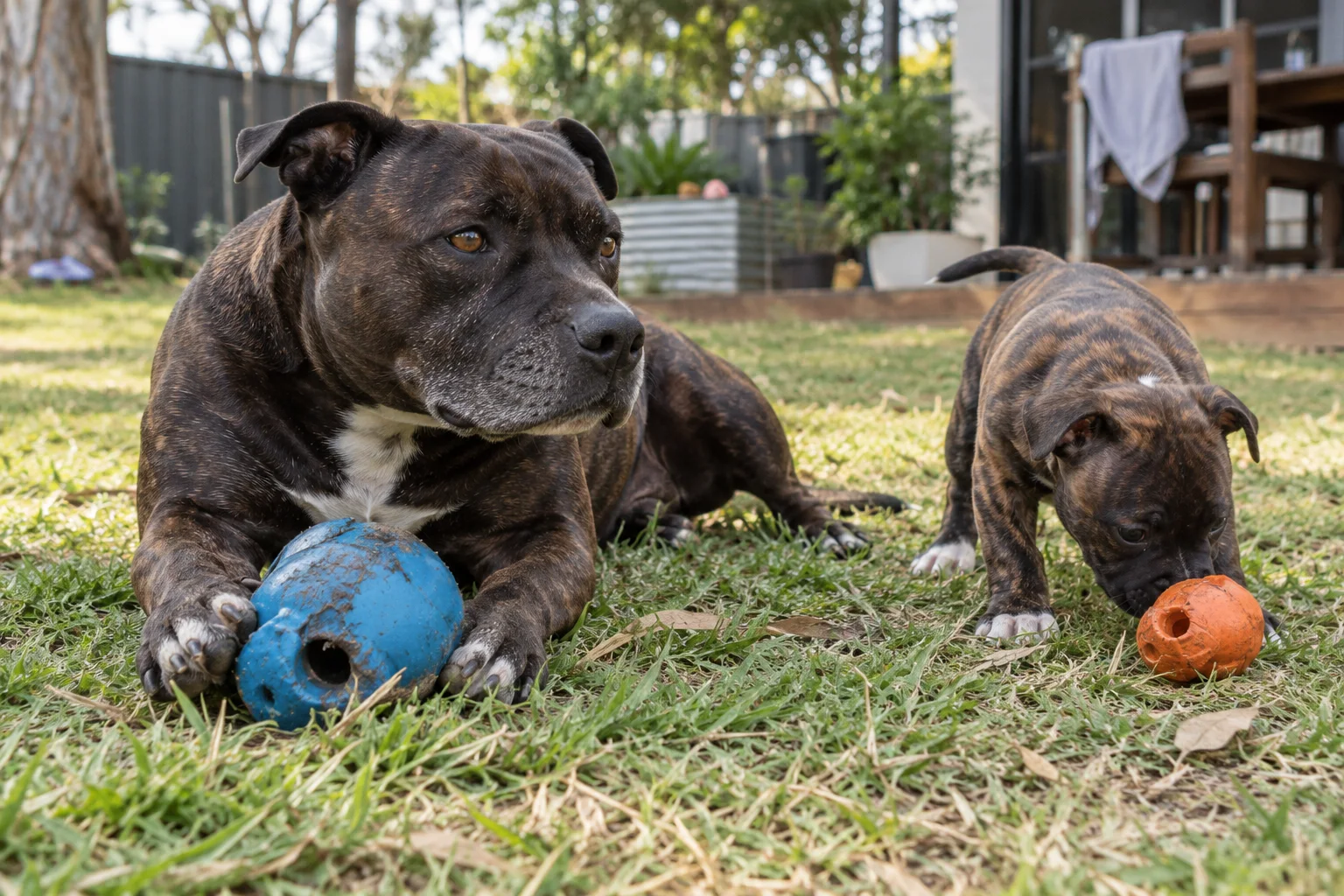
The Staffordshire Bull Terrier is a muscular, medium-small terrier commonly called the Staffy in Australia. It is a distinct breed from the American Staffordshire Terrier. Dogs Australia describes Staffies as intelligent, affectionate and people-oriented, while also bold, active and strong.
- Typical fit: owners wanting an involved indoor companion and daily activity
- Activity: energetic walks, play, sniffing and training
- Coat: short and simple to brush; skin may need extra attention
- Training: enthusiastic and capable, with consistency essential
- Big commitment: secure management, comfortable alone-time skills and safe outlets for chewing
What is a Staffy’s temperament like?
Many Staffies are exuberant with people and happiest in the middle of family life. Individual dogs still differ, and breed is never a guarantee of behaviour. Genetics, early experience, pain, training and environment all matter. Reward calm greetings and four paws on the floor rather than waiting for adolescent enthusiasm to disappear by itself.
For local ownership questions, see our Queensland and Brisbane guide to prohibited breeds and dangerous-dog declarations, including the distinctions between Staffies, Amstaffs and Pit Bull Terriers.
Exercise, play and strong jaws
A healthy adult generally needs purposeful activity every day. Mix walks and sniffing with short training games and supervised play. Repetitive high-impact exercise is not appropriate for growing puppies. On hot days, move activity to cooler hours and watch for overheating.
Choose toys by the individual dog, not by an “indestructible” claim. Supervise new items, use a size that cannot be swallowed and remove anything that cracks, splinters or sheds pieces. Extremely hard chews can fracture teeth. Food-stuffed rubber toys and scent games can give strong chewers a job without encouraging frantic arousal.
Training and life with other dogs
Teach recall, loose-lead walking, leave, drop, mat settling and cooperative handling. Use secure fencing and a lead where required. Dog sociability varies: some adults enjoy suitable canine friends, while others prefer space. Do not rely on a dog park to provide socialisation, and never force close greetings. A qualified reward-based trainer can help with lunging, fear or conflict.
Children and family life
Staffies can be loving family companions, but no breed is automatically safe with children. Excitement and strength can knock a child over. Adults should actively supervise, give the dog a child-free resting place and teach children not to climb on, disturb or take things from a dog. Separate whenever supervision is not possible.
Coat, skin and health
The short coat needs routine brushing, nail care and checks of ears, teeth, paws and skin. Persistent scratching, red paws, recurrent ears or hair loss deserve veterinary assessment rather than repeated home remedies.
Dogs Australia recommends breeders test for L-2-hydroxyglutaric aciduria (L2-HGA), an inherited metabolic disorder, and hereditary cataracts. Ask to see results for both parents, and discuss eye, skin and joint history. Avoid dogs with exaggeratedly short muzzles or noisy, restricted breathing.
Is a Staffy right for you?
A Staffy may suit a household prepared for an affectionate, physical companion and consistent everyday training. It may be a difficult fit if the dog will be isolated outside, chewing and alone-time skills cannot be managed, or the household wants effortless harmony with every unfamiliar dog. Consider rescue as well as responsible registered breeders; an adult’s established behaviour may make matching easier.